TESTIMONY OF DEFENDANT SARA CANTOR
This is a retelling of the testimony of Sara Cantor, police liaison at a tax day action in 2024 on the Golden Gate Bridge, demanding an end to our tax-funded U.S. aid to Israel to conduct genocide and ethnic cleansing in Gaza. Sara’s testimony is drawn by way of direct examination by Sara’s counsel, Attorney Jac Lyons; by cross-examination by Assistant District Attorney Angela Rose; through her responses to questions from the engaged jurors; and assorted follow-up examinations.
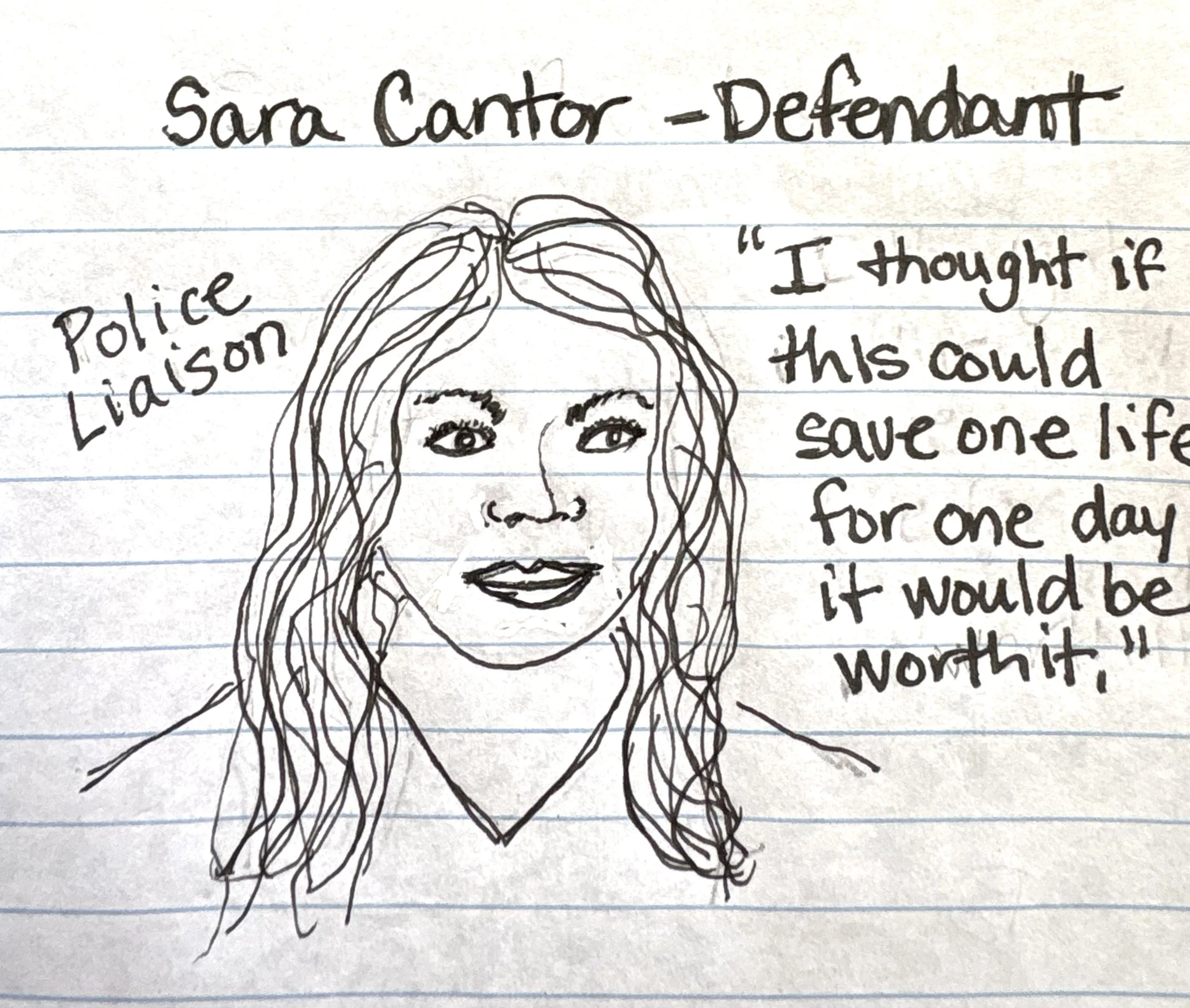
Courtroom sketch from defendant Sara Cantor’s testimony. Sketch by: Laurie Moorhead
Sara is a 37 year old freelance paralegal and trained accountant, raised in San Diego and a Bay Area resident of nearly 15 years. Prior to her current paralegal work, she worked at the East Bay Community Law Center and was grateful for an opportunity to help people get access to legal services regardless of their ability to pay because she believed everyone has a right to a legal defense. Sara, who grew up Jewish, recalled her exposure to the one-sided narrative of the founding of Israel as a natural outcome of the Jewish Holocaust, where Palestine was just seen as ‘a land without a people for a people without a land’. Sara was initially ‘confused’ when she learnt that people lived on Palestinian land before the founding of Israel and Palestinians were kicked out to make way for Israeli settlers to move in. She wanted to learn more because Israel existed in the name of her people, and it was important to learn what was being done in her name.
After Israel’s ongoing escalations turned into an outright genocide in Gaza in October 2023, Sara knew “it was happening in my name as both an American and a Jew.” The genocide was being supported by her government, and she was living in the heart of the empire enabling this genocide. In response to ADA Roze’s now predictable objection, Judge Caffese recounted to the jury the limiting instruction that parts of Sara’s testimony related to what she had learnt from other sources was hearsay and wasn’t to be considered evidence in the facts of the matter at hand.
Sara continued her testimony. She kept herself informed of the unfolding genocide in Gaza through social media accounts of journalists in Gaza and US outlets such as the New York Times and The Washington Post. She followed updates from Motaz Azaiza, Plestia Alaqad, and Bisan Owda, as they live-streamed the genocide of their own people. Sara shared that Bisan was living in Gaza City and was a part of the mass exodus of Palestinians on foot from the North to the South. The bombings of Al-Shifa Hospital stuck with Sara, and she felt like ‘every second, it was all I could think about.’ She thought of the people dying, and the people still alive that could be saved. Sara testified that even though she had seen horrible things happen to people before, what she was witnessing in Gaza felt extremely different. As a child raised with Holocaust education, she would ponder over the question, “who would I have been if I had lived during that time…would I have gone on with my everyday life or would I have resisted?” Sara promised herself as a child that she would do everything that she could. The genocide in Gaza was history repeating itself and she couldn’t look away.
Sara testified to the acceleration of the genocide in Gaza. Every day she would wake up and see something worse than the day before. “It felt like the bottom was falling out from under me.” In April 2024 the urgency had increased as Israeli Prime Minister Benjamin Netanyahu announced the invasion of Rafah, Gaza’s only ‘safe zone,’ where over a million and half displaced Palestinian’s sought shelter in tent cities in the middle of a desert. This was an emergency on a massive scale, actively unfolding in front of her eyes, happening to people she had grown to care about deeply. The renowned journalist Bisan started her social media posts with ‘This is Bisan, and I am still alive’ and Sara became accustomed to waking up every morning to check if Bisan was still alive. She had developed a feeling of closeness with these story-tellers and Bisan was in Rafah during the time of the announced invasion.
Sara testified that she had done everything that she could. Sara was actively involved in the government of the city of Richmond, and is a firm believer in the power of grassroots organizing and regular people getting involved to effect change. She was proud to participate in Richmond becoming the first city in the country to pass a ceasefire resolution. She tried reaching state and federal governments through petitions and using the 5 Calls app to call her elected officials daily. At first she would get a person on the line, but that quickly changed to voicemails and auto-generated emails. In the upcoming months Sara attended a Ceasefire Mass Meeting open to the public attended by over 300 people. The breakout room Sara was assigned to was led by Gopal Dayaneni, an academic and activist in the Bay Area with expertise on the power of protests and civil disobedience to bring about lasting change.Through this training, Sara learnt of ways in which regular people could intervene to demand change. In October 2023, Sara participated in the protest in San Francisco attended by over 50,000 people. In November 2023 she participated in the sit-in at the federal building in Oakland to demand a ceasefire. She fundraised for people to leave Gaza from the Rafah Crossing into Egypt. When powerful decision makers came to the Bay Area she attempted to speak with them directly, including at a dinner with Chevron executives and a gala attended by Nancy Pelosi. While the people were overwhelmingly in support of a ceasefire, the US government was increasing military aid to Israel. Sara had exhausted all possible avenues to voice her demands, and at this point reflected on her training with Gopal Dayaneni and other forms of public interventions that had been effective in the past.
When April 2024 came around and Sara heard about the imminent invasion of Rafah, the only ‘safe’ zone in Gaza, she felt the need to act. She knew the genocide would not be possible without American support and that the funds were sourced from our tax dollars. Taking action on April 15th felt apt due to the symbolism of tax day in the US and the existing call for an international day of action - an opportunity to participate in a global outcry that would be more impactful than anything done individually. Over 1.4 million people in Rafah were in danger and if her actions would save even 1 life, it would be worth it. Sara testified that she would not have taken an action that impacted so many others if it wasn’t absolutely necessary to do so.
Prior to the action, Sara did not know of the existence of the Golden Gate Bridge Authority or the fact that the bridge was a business. On April 15th she was on the bridge in the role of a Police Liaison (PL), a common role in protests. The PL is the point of contact between protestors and law enforcement to keep people safe and avoid instances of police brutality. Sara assumed this role because as a white woman she was typically treated respectfully by the police. With this privilege she could help protect people who had realistic fear of law enforcement. Sara had received de-escalation training at her prior place of work and felt she had accomplished the goal of keeping things calm and smooth at the April 15th, 2024 action, outside of prosecution witness JW’s attack on the protestors.
Sara had expected law enforcement to open up the 4th lane of traffic and the protestors were ready to let vehicles through in case of emergencies. Sara testified that the protestors did not want to endanger any lives on the bridge to save others and would have abandoned the protest if it had become necessary. She knew that if there was a true medical emergency, they would be rerouted through the northbound lanes blocked by law enforcement. She felt like people were taken care of. Sara believed her actions were legally justified, and protected by the necessity doctrine, principles of which have been applicable to protest cases and ones she’s been aware of for a while. What is typically considered unlawful can be deemed lawful in an emergency. And what was happening in Gaza on our dime was just that. Sara cared about the wellbeing of the commuters and had spent hundreds out of pocket to buy water, granola bars, and gluten free snacks that were distributed on the bridge that day until the police line blocked the protestors from passing these out.
At the meeting on the eve of April 15th, 2024 at an Animal Rights venue in Berkeley - Sara remembered a big bunny on the wall - she facilitated a ‘know your rights and risks’ training. The meeting was attended by upwards of 50 people. Sara discussed the necessity defense that had been applicable in past animal rights cases. She read the definition and elements of the necessity doctrine out-loud and asked people to assess their risk tolerance - following which some left. When asked by Attorney Lyons why she thought her actions on the bridge were protected by the necessity doctrine ADA Roze objected to the question and the judge struck it from the court record.
Attorney Lyons asked Sara to remind the jury of the 2 charges specific to her. Sara is charged with failure to obey the orders of a uniformed officer and failure to disperse at the scene of a riot. The first commanding officer Sara interacted with was Captain Elauria, with whom she initiated contact. It was loud as speeches were being projected using a bluetooth speaker and there were “many voices in unison”. Given how loud it was, Sara asked Captain Elauria to speak somewhere else. Elauria was irritated and stated multiple times in succession that “they need to move their cars” to which Sara acknowledged that she heard him. Captain Elauria did not ask Sara to do anything, she was not escorted anywhere, was free to move around, and was never asked to leave the bridge. She told Elauria that the people in the lock-boxes would not voluntarily leave and the fire department would have to come and cut them out. Throughout the protest, Sara proactively introduced herself to and checked in with law enforcement officers and offered them snacks and water.
Later that morning, Sara interacted with Sergeant Langford who also did not ask her to leave the bridge. He was standing on the sidewalk and Sara approached him and did her usual, pleasant introduction. Langford informed Sara that he was trying to disperse the protestors. He shared emergencies experienced by commuters stuck on the bridge. All were instances of people not being able to get to work and none were medical emergencies. Sara reminded Langford of the option of opening up the fourth lane for commuters to exit the bridge and the protestors were ok with commuters bypassing the assembly.
An hour and a half after her interaction with Langford, Sara met Captain Carlton. She was not confined or placed under arrest at this time and was not told to go or stay anywhere. Captain Carlton approached Sara and let her know that the protestors would be placed under arrest and asked if they would comply. After checking with the protestors, Sara informed him that the protestors on foot would comply, the protestors in lockboxes would not resist arrest but they would not voluntarily unlock themselves. Langford, in his frustration, raised his voice at Sara, but Sara remained calm throughout. She regularly checked in with law-enforcement and the officers were generally respectful to her. The officer who drove her off the bridge thanked her on behalf of the group for the cooperative conduct of the protestors.
Sara testified that she believed the action was effective. On May 7th, 2024 President Joe Biden ordered a pause on weapons shipments for the invasion of Rafah.
In her cross-examination of Sara Cantor, ADA Roze attempted to solicit information on the planning of the action and reactions to hypothetical impacts of the bridge action. Sara shared that at the April 14th, 2024 pre-action meeting, all defendants except Conrad De Jesus were present. ADA Roze asked if Sara was following the instagram page for A15 actions and whether the goal was to cause the most economic impact. That was the stated goal on the instagram page, Sara shared. When was it decided that the Golden Gate Bridge would be the site of the protest? On the eve of the action, Sara shared. How did Sara get recruited to participate? She was invited to a signal group, created 2-7 days prior to the action, where people reached out to others in their community and were added in. ADA Roze inquired why the Golden Gate Bridge was chosen? Sara shared that the GGB was an iconic spot in the city, the site of the Stop AIDS Now or Else action from 1989 that took place the month she was born, and San Francisco was an economic hub in the Bay Area so it made sense. ADA Roze asked if Sara was aware of arrests in the Bay Bridge protest case in the previous year. She was aware of the arrests and was also aware that no one was convicted. Roze asked Sara if she had participated in any Know Your Rights training and if that included the ACLU. Sara had, as she described in her direct, but not ACLU specifically. ADA Roze asked if Sara knew that blocking a roadway was illegal and it would result in an arrest to which Sara responded that it was illegal under some circumstances but didn’t think there was a correlation between the likelihood of arrest and the legality of things. People that have not broken any laws often get arrested.
Roze asked Sara if she thought the action was thoughtfully planned, to which Sara responded that she tried not to be reckless and blocking roadways is something that is a tried and true way to effectuate change. When asked about her involvement in the Chevron dinner, Sara emphasized that she was present but did not participate in the disruption. When asked questions about the assignment of roles, Sara said she volunteered to be Police Liaison but did not know how other roles were assigned. The general plan discussed was two rows of 3 cars would drive onto the bridge and the protestors in the lock-boxes would disentangle for medical emergencies. Roze was curious as to why the middle of the bridge was decided to be the site of the action and if that had any bearing on creating the maximum economic impact. Sara shared that she didn’t think the economic impact, inconveniencing the most people, or accessibility to law enforcement were considered in this decision and the location simply had the best optics for an action meant to garner the most attention. Roze asked who decided if an event on the bridge qualified as an emergency to which Sara responded that we had a vetted system of calling 911, if they determined something was an emergency that could be passed onto Langford who would have a way to determine if the event qualified. Sara shared that she had offered to open up a fourth lane and didn’t expect to have any say in who could pass through and who couldn’t. She expected that law enforcement would control and direct traffic at that point.
The jury had a range of questions for Sara. They were curious what her work as a paralegal entailed, details of which Sara was delighted to share. Did she suggest to the cops to help cars off the bridge from the North? She didn’t recall doing so specifically. How long did she expect the protest to last? Sara’s expectation was an hour maximum - or however long it would take for the lock-boxes to be cut through. Did they prepare a plan for the protestors to use the bathroom? Not specifically. Who decided what would qualify as a motorist emergency? It was up to 911 and emergency services and besides, no emergencies were reported. Why wouldn’t Sara let emergency situations through? Sara said she wasn’t making decisions on behalf of other protestors, simply communicating, and reiterated that no emergencies were reported to her. Why was it important to block 3 northbound lanes? This decision was inspired by past effective actions. Why didn’t the protestors consider leaving 1 or 2 lanes open? Because it would be dangerous to protest alongside lanes of fast moving traffic. How did she personally anticipate getting off the bridge? She expected an arrest to be the most likely scenario or driving off if they had to abandon the protest to allow for emergency pass throughs. How did she know that a 4th lane could be immediately opened? Because it seemed intuitive that the 4th lane could be opened up quickly and it happened regularly. Were 2 medics part of the group? Yes, and they were available to anyone who needed them. Why didn’t she end the protest when she learnt the 4th lane wouldn’t be opened up? Because it wasn’t her choice. How would she distinguish between a medical and non-medical emergency? It was not her job, but within the purview of law enforcement and emergency response teams. She considered something an emergency if there was harm to someone’s life. What led you to believe that the 4th lane could be opened? It was her understanding, and it is what she would do if she were a cop! Did she know anything about the February 14th, 2024 action? Only that it happened. Was she anticipating the north bound lanes to be closed? That was completely unexpected. What was she expecting with the 4th lane? That law enforcement will do their job. Did the black Honda CRV belong to one of her codefendants? She did not know. Was she concerned about suicide attempts or panic attacks? Sara was aware of suicide nets installed on the Golden Gate Bridge and was concerned about the emotional impact of the action and would have pursued another option, if there was one. Did she consider other contingency plans? To fully abandon the protest in case of medical emergencies.
In the follow-up cross-examination Sara reminded ADA Roze that she did not have the ability to disperse the protest herself and nothing actually occurred that would reach that point.