TESTIMONY OF DEFENDANT CONRAD DE JESUS
Today was the first day of the defense’s presentation in front of the jury. Two defendants, Conrad De Jesus and Sara Cantor, presented their testimonies by ways of direct examination from their counsel, Katy Isa and Jac Lyons respectively; cross-examination with Assistant District Attorney Angela Rose; and in response to questions from our engaged jurors.
Of all the words we have been hearing in the case, the testimonies of defendants cannot be summarized. It is impossible to paraphrase their own accounts of why they protested the genocide in Gaza. For this reason, the summary offered below attempt to stay as close as possible to the speech shared by the defendants in the courtroom.
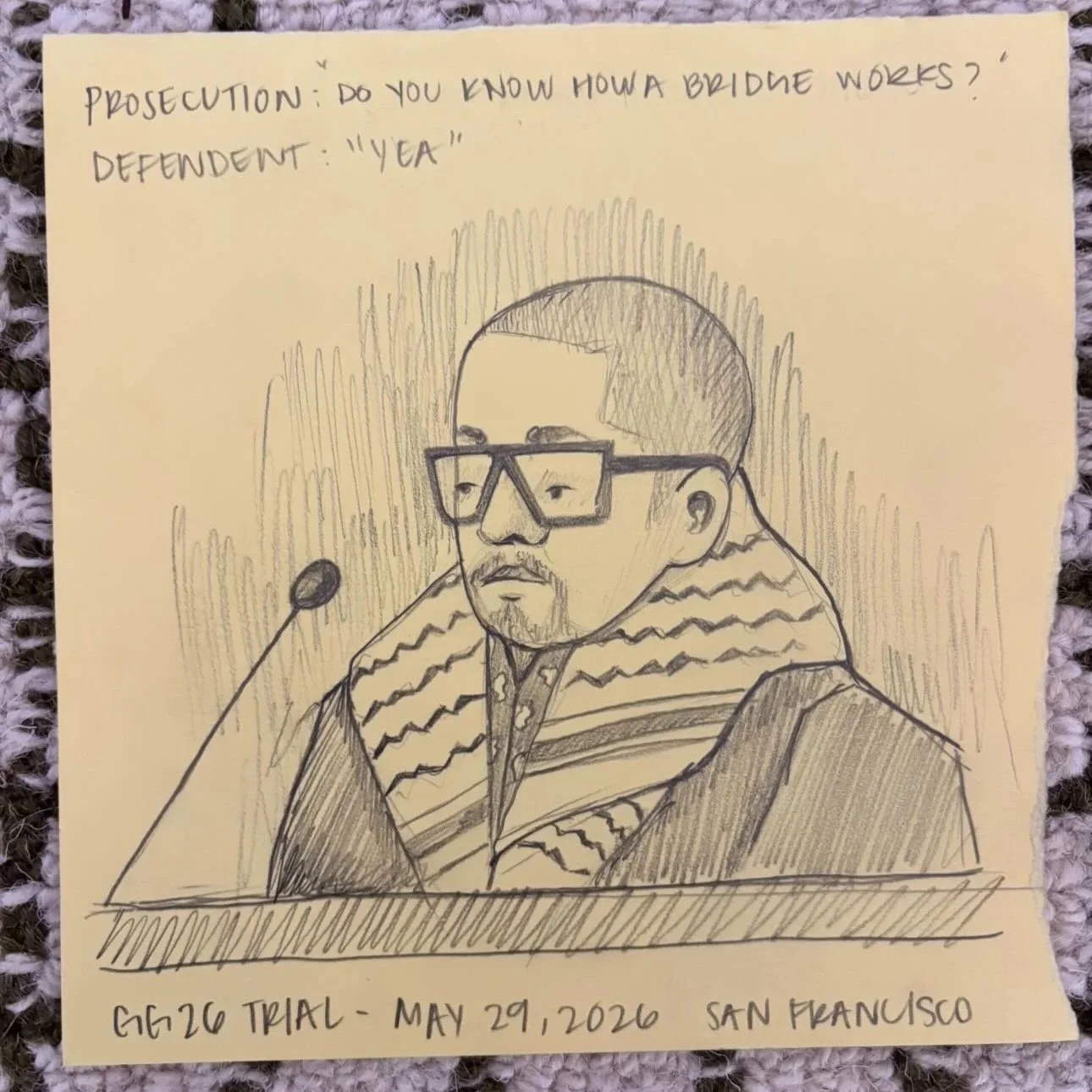
Courtroom Sketch from Conrad De Jesus’s testimony. Courtesy: @messybeck on instagram
Conrad is a 1st generation Filipino immigrant, father of 2, practicing architect, animal and human rights activist. His experiences living across 3 continents shape his beliefs and advocacy for social justice. At a very young age he saw the parallels between apartheid in South Africa and Israel’s military occupation of Palestine. Advocating for social justice was important to Conrad because “Even though we are just a few people, we are all interconnected, and what one does reflects on our society as a whole.” Once Conrad’s kids grew older and independent, he committed his life to activism and to educating himself on the range of what plagued our global societies. He recounted a lecture by Captain Paul Watson he attended at Sonoma State University about protecting our oceans and learning every 2nd breath we take comes from our oceans.If the Oceans Die, We Die. The learnings from this lecture led Conrad to join and work with the Paul Watson Foundation, a charity dedicated to ocean conservation.
ADA Roze interrupted Conrad’s testimony asking the judge to brief the jury on a “limiting instruction”. Judge Caffese accepted the objection and informed the jury that anything that Conrad heard ‘was not to be considered as evidence’ as it was considered hearsay in the court of the law. Conrad continued and talked about his veganism, asking: “why protect ocean life and not life on land?”
Conrad described his involvement with Direct Action Everywhere, a global network of activists working to achieve social and political change for animals in one generation. He participated in open rescues where animals in distress are saved from the clutches of factory farms, explaining the right to rescue these animals in distress that may be subject to cruelty which is protected by the necessity defense. The necessity defense is the legal defense according to which conduct deemed ‘illegal’ is justified to prevent a greater, imminent harm. In the animal rights world, an open rescue, considered illegal, was always the last resort to save an animal’s life. An activist would begin with investigating, photographing, and documenting the abuse. They would share this information with local law enforcement, district attorneys, and other officials with the authority to stop the abuse. An open rescue would happen only if these actions yielded no results. Conrad recounted his motivation: animals deserved dignity, and animal cruelty should not exist anywhere. Conrad began sharing his experience rescuing beagles bred for laboratory experimentation. ADA Roze once again interrupted Conrad’s testimony requesting a “limiting instruction” to the jury. Judge Caffese accepted this interruption and recounted to the jury that anything Conrad heard was to be excluded from evidence in their deliberations but may come in for some other purpose. The judge asked Attorney Isa to ‘hurry along’ and get to the action.
Conrad testified that his participation in open rescues was based on the belief he has held for more than ten years: that he had a right to do so. Conrad’s advocacy for Palestinian human rights stems from an understanding of the Palestinian cause from his childhood in Saudi Arabia and from staying in touch with friends from the region. This advocacy took shape with the assasination of Palestinian-American journalist Shireen Abu Akleh as she reported from the West Bank. Conrad sought organizations that would allow him to go to Palestine for humanitarian work but with the start of the ongoing genocide in Gaza and escalating miliary and settler violence across Palestine he wasn’t able to actualize this goal. He attended a march in San Francisco attended by over 50,000 Bay Area residents demanding a ceasefire in Gaza. He attended a public hearing in Oakland calling for a ceasefire. Conrad recounted the story of Hind Rajab, a 6 year old child shot over 300 times by the Israeli military as she waited to be rescued from a car with her murdered family. Palestinian rescue workers seeking to save Hind were also murdered by the Israeli military.
As a father, Conrad could not stay silent. He tearfully began recounting the story of a father of a four year old girl, murdered in the genocide: “I was watching a news source showing rescuers at a collapsed apartment building. They were digging through the rubble and recovered the body of the child who was pale, even grey from all the concrete dust. Her father cradled her lifeless body in his arms and cried in anguish. Living in Saudi, I learned Arabic words which I thought I heard. I realized I didn’t need to translate since I already knew what he was saying. They were the same words I would have said if I had my daughter in my arms. ‘Daddy’s here baby girl. Please wake up.’”
ADA Roze interrupted his testimony once again, asking the judge for the standing limiting instruction to the jury. Despite being a standing instruction, the judge allowed this interruption and recounted the limiting instruction to the jury in the middle of Conrad’s story.
Conrad testified that no legal avenues were proving to be effective, the massacres continued, and the number of fatalities went up. It was important to speak up and to be part of the “snowball effect” that would actually end these atrocities. Around April 2024 he learnt of an $18 billion aid package to Israel being approved by US congress. Conrad learnt of an action at Lockheed Martin, one of the largest arms manufacturers in the US and arms supplier to Israel in the ongoing genocide. The goal of the action was to block entrances to the Lockheed Martin facility in the South Bay. He was first introduced to the ‘Sleeping Dragons’ or lock-boxes used in the April 15th, 2024 action on trial at the Lockheed action. While he knew Rocky through his animal rights activism, this was the first time he met River, over a post-action lunch at a vegan restaurant. Conrad considered the Lockheed Martin action a success as the location halted on-site operations for the rest of the day.
The Israeli genocide in Gaza was an emergency, Conrad testified. Within the next few days Conrad learnt that while Palestinians were being pushed into Rafah, the Israeli military was threatening to invade it, the only safe zone. Just days before the tax day action, World Central Kitchen employees were attacked and murdered by Israeli forces. Conrad believed that he had every right to take action - to save lives - and that his actions would be protected by the necessity defense. Conrad testified that he had exhausted all other options, from permitted marches, to public meetings, to speaking to his elected representatives. It was time to take bold enough action that would catch the attention of our elected representatives. He learnt about a tax day action and attended a meeting on the invitation of a fellow activist on the eve of April 15th, 2024. He didn’t know the Golden Gate Bridge was a business at the time, and believed his actions would be justified to prevent a greater evil. He first met Sarah Ferell, the defendant he was later attached to in the lock-box, at the Ashby Bart station in the East Bay on the morning of April 15th, 2024 where the activists began their journey to block the Golden Gate Bridge. On the bridge, Conrad testified, he recalled prosecution witness JW charging aggressively, shouting profanity, and approaching his car on at least 2 occasions. The protestors on foot protected him in his vulnerable position. The actions of the protestors on foot were consistent with what he had learnt from de-escalation trainings, such as informing JW that ‘he was being filmed’ in an effort to get him to be less aggressive. Conrad’s intention was not to inconvenience drivers that day but to bring to light the deteriorating situation in Palestine. He did not intend to interfere with the Golden Gate Bridge’s business because at the time, he didn’t know it was a private business - but believed that, like every other local bridge, it belonged to the State of California.
Conrad believed his actions on the Bridge that day would have an impact as it was happening concurrently with actions across over 80 cities in the United States. Even after the action he attended rallies and marches since the ceasefire in Gaza wasn’t in fact a ceasefire and dozens of Palestinians were still being murdered daily. Conrad reiterated that he believed that his actions were justified and protected under the necessity defense.
ADA Roze’s cross examination focused on extracting names of people Conrad was in touch with before and during the action and what ‘public postings’ he got his information from. She wanted to know who briefed Conrad on the action, if he knew who the Black Honda CRV seen in the February 14th, 2024 and April 15th, 2024 action belonged to. ADA Roze was surprised that Conrad didn’t know a lot of people from the protests and city council meetings he participated in, to which he responded that ‘he wasn’t very talkative’. She asked Conrad if ‘as an experienced activist’ he had ‘read the ACLU (American Civil Liberties Union)’. ADA Roze asked Conrad if he knew that blocking or obstructing roadways was illegal. He responded that there could be exceptions, protected by the necessity defense. She asked if Conrad had reached out to the California Highway Patrol or the Golden Gate Bridge to ask if his protest would be lawful. He did not. Had he requested a permit to block the bridge? He had not. She asked Conrad if he knew how a bridge worked. As an architect, he did. She asked him if he knew that his actions would impact drivers behind him, and if impacting that many individuals was important to the action. Conrad re-iterated that it was important to take bold action to capture the attention of elected officials. ADA Roze quipped that he had practiced that answer many times. The defense objected to this rudeness, one that Judge Caffese sustained.
Attorney Isa asked Conrad ‘why on Earth’ would he get up early and ‘interlock his arms with a stranger’ knowing that this would likely lead to him being arrested. Conrad responded that he did that because it was an emergency. Attorney Isa further asked if Conrad had learnt in Wayne Hsuing’s case that the necessity defense didn’t apply to animals, just humans, but whether his acquittal alongside other animal rights cases being acquitted and dismissed informed his decision that his actions would be protected. Yes it did, Conrad testified, adding “when I saw animals could be saved, why wouldn’t I try to save humans?”
The jury had a range of questions for Conrad. How many languages did he speak? 3 or 1.5 depending on how one graded proficiency. Was he paid any money to participate in the action? No, he was not. How does his belief that the world is interconnected and we must take responsibility for our impact factor into his activism? Conrad responded that everything he did was because all sentient beings had a right to be happy and safe. Did he participate in protests that were previously vetted or based on ‘blind’ trust? Protests were usually vetted. How was it decided who would be connected in the sleeping dragons? It was voluntary. Could he have opted out? Yes, but he didn’t because this was an emergency and he wanted to do everything he could to bring attention to the US complicity in the genocide in Gaza. Did he intend on blocking the bridge on April 15th, 2024? Yes, he did. How did he determine if something qualified as an emergency on the bridge that day? He didn’t see any emergency. Did he create a ballot measure? Creating a ballot measure wasn’t within his skill set, but he would support it.